 SIGN IN
Some days you push. Some days you pause.
The ATTIKA Way
Many of us have been taught that a successful workout should leave us exhausted.
Sweaty.
Out of breath.
Sore the next day.
We learn to judge a session by how many calories we burned, how much weight we lifted, how many rounds we completed, or how hard we pushed ourselves.
And while progressive overload and building resilience is necessary for seeing results, that's only part of the picture.
The truth is, your body doesn't progress in a straight line.
Some weeks you feel strong, energised, and ready to push.
Other weeks you feel tired, stressed, sore, or simply not at your best.
That's normal.
It's human.
Yet many people respond to those days by trying to push harder.
They force the workout.
They ignore the signals.
They convince themselves that slowing down means they're falling behind.
But often, the opposite is true.
Progress doesn't happen during training
Training creates a challenge.
Recovery is where adaptation happens.
Your muscles don't become stronger while you're lifting weights. They become stronger afterwards, when your body has the time and resources to recover and rebuild.
The same applies to your nervous system, energy levels and mindset.
Without enough recovery, the body never gets the opportunity to fully adapt.
That's why pushing harder isn't always the answer.
Sometimes the smartest thing you can do is pause.
Some weeks need more pause
You may have your recovery days dialled in. Training two or three times a week, taking regular rest days, sleeping well, eating well, and making time for mobility, stretching, and nervous system practices. If that's you, congratulations. You're already doing a lot of things right.
But that doesn't mean you'll always be ready to push.
Hormonal changes, subconscious stress, emotional challenges, poor sleep, travel, or even fighting off an illness before symptoms appear can all impact your training more than you realise. That's why it's important to listen to your body on the day, not just follow your programme regardless of how you're feeling. Some days you'll be ready to push. Other days, your body may need more recovery. Learning to recognise the difference is part of the process.
Pausing is not doing nothing
When people hear the word "recovery," they often imagine sitting on the sofa and doing nothing.
But recovery can be active.
It can be a mobility session.
Breathwork.
Gentle movement.
Working on flexibility.
Practising control and technique.
Spending time reconnecting with your body instead of demanding more from it.
These sessions may not feel as productive as a hard workout.
They may not leave you drenched in sweat.
But that doesn't make them less valuable.
In many cases, they're exactly what your body needs.
The fitness you don't see
It's easy to celebrate adding weight to the bar.
It's harder to appreciate improvements that aren't as visible.
Moving through a greater range of motion.
Improving balance and coordination.
Learning to control a movement rather than simply complete it.
Breathing more efficiently.
Reducing stiffness and discomfort.
Recovering faster between sessions.
These qualities may not be as exciting as chasing personal bests, but they create the foundation that allows you to keep progressing long term.
Better mobility helps you move more safely.
Better flexibility allows you to access positions with greater confidence.
Better control improves performance and reduces injury risk.
Recovery helps ensure you can show up again tomorrow.
These aren't distractions from progress.
They are progress.
Listening instead of fighting
One of the most important skills you can develop is learning the difference between discomfort that helps you grow and signals that your body needs something different.
Sometimes growth comes from pushing through challenges.
And other times, growth comes from respecting your limits.
It’s strong to lift the heavier weight, but sometimes it's stronger to choose the lighter one.
Both have a purpose.
But how do you know when to push or pause?
We´re not saying if you don´t feel like working out, just don´t do it.
The mind can be convincing if you´re feeling a little tired or distracted, but after a good warm-up and motivational talk from your trainer, it could be the perfect time for a push day. So how do you know?
As we said, always start with the warm-up and see how you feel. Sometimes that is all you need to get the blood pumping and let the body know it´s safe to move. If your body still feels heavy or depleted, it´s a good sign it needs more light movement, at least until it starts to improve.
Heavy soreness from a previous workout means that, in that area at least, movement should be kept light.
Your training plan will also tell you how your body is doing compared to last week. If you find you cannot lift the same weight for the same amount of reps with good form, it´s a sure way to see that your body simply isn´t as strong.
The balance that creates long-term progress
People often think success comes from constantly pushing.
In reality, success comes from balancing stress and recovery.
The people who make progress for years aren't the ones who push hardest every single day.
They're the ones who know when to push and when to pause.
They understand that both have a role to play.
That both are part of the process.
That both move them forward.
Push when it's right.
Pause when it's needed.
Both move you forward.
They're often the ones who have become excellent at listening to it.
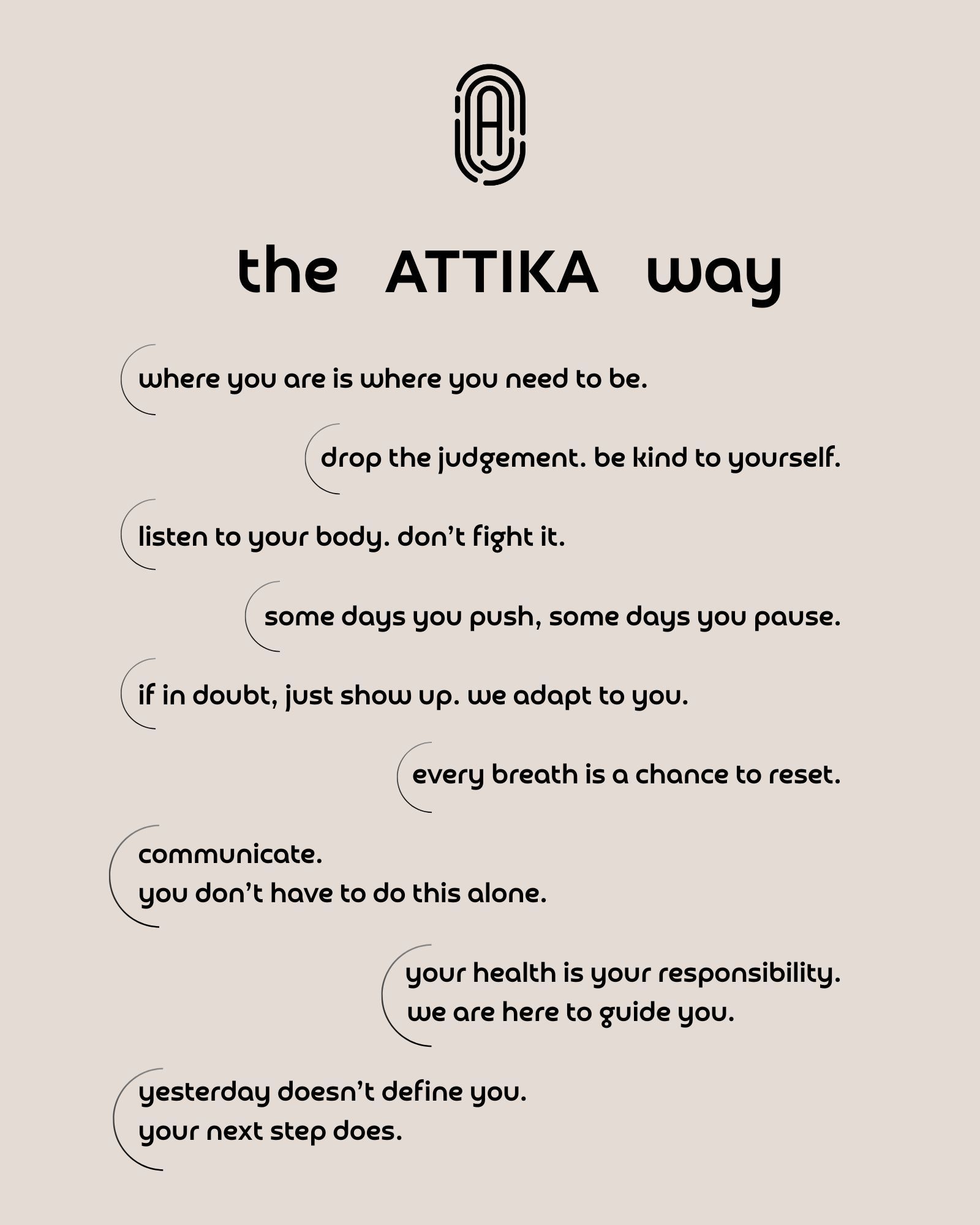
¨Some days you push, some days you pause¨ is part of the ATTIKA Way.
The ATTIKA Way is a list of reminders of how we approach health in a healthy way.
With more kindness, less pressure, and a focus on building habits that actually last.
Many of us have been taught that a successful workout should leave us exhausted.
Sweaty.
Out of breath.
Sore the next day.
We learn to judge a session by how many calories we burned, how much weight we lifted, how many rounds we completed, or how hard we pushed ourselves.
And while progressive overload and building resilience is necessary for seeing results, that's only part of the picture.
The truth is, your body doesn't progress in a straight line.
Some weeks you feel strong, energised, and ready to push.
Other weeks you feel tired, stressed, sore, or simply not at your best.
That's normal.
It's human.
Yet many people respond to those days by trying to push harder.
They force the workout.
They ignore the signals.
They convince themselves that slowing down means they're falling behind.
But often, the opposite is true.
Progress doesn't happen during training
Training creates a challenge.
Recovery is where adaptation happens.
Your muscles don't become stronger while you're lifting weights. They become stronger afterwards, when your body has the time and resources to recover and rebuild.
The same applies to your nervous system, energy levels and mindset.
Without enough recovery, the body never gets the opportunity to fully adapt.
That's why pushing harder isn't always the answer.
Sometimes the smartest thing you can do is pause.
Some weeks need more pause
You may have your recovery days dialled in. Training two or three times a week, taking regular rest days, sleeping well, eating well, and making time for mobility, stretching, and nervous system practices. If that's you, congratulations. You're already doing a lot of things right.
But that doesn't mean you'll always be ready to push.
Hormonal changes, subconscious stress, emotional challenges, poor sleep, travel, or even fighting off an illness before symptoms appear can all impact your training more than you realise. That's why it's important to listen to your body on the day, not just follow your programme regardless of how you're feeling. Some days you'll be ready to push. Other days, your body may need more recovery. Learning to recognise the difference is part of the process.
Pausing is not doing nothing
When people hear the word "recovery," they often imagine sitting on the sofa and doing nothing.
But recovery can be active.
It can be a mobility session.
Breathwork.
Gentle movement.
Working on flexibility.
Practising control and technique.
Spending time reconnecting with your body instead of demanding more from it.
These sessions may not feel as productive as a hard workout.
They may not leave you drenched in sweat.
But that doesn't make them less valuable.
In many cases, they're exactly what your body needs.
The fitness you don't see
It's easy to celebrate adding weight to the bar.
It's harder to appreciate improvements that aren't as visible.
Moving through a greater range of motion.
Improving balance and coordination.
Learning to control a movement rather than simply complete it.
Breathing more efficiently.
Reducing stiffness and discomfort.
Recovering faster between sessions.
These qualities may not be as exciting as chasing personal bests, but they create the foundation that allows you to keep progressing long term.
Better mobility helps you move more safely.
Better flexibility allows you to access positions with greater confidence.
Better control improves performance and reduces injury risk.
Recovery helps ensure you can show up again tomorrow.
These aren't distractions from progress.
They are progress.
Listening instead of fighting
One of the most important skills you can develop is learning the difference between discomfort that helps you grow and signals that your body needs something different.
Sometimes growth comes from pushing through challenges.
And other times, growth comes from respecting your limits.
It’s strong to lift the heavier weight, but sometimes it's stronger to choose the lighter one.
Both have a purpose.
But how do you know when to push or pause?
We´re not saying if you don´t feel like working out, just don´t do it.
The mind can be convincing if you´re feeling a little tired or distracted, but after a good warm-up and motivational talk from your trainer, it could be the perfect time for a push day. So how do you know?
As we said, always start with the warm-up and see how you feel. Sometimes that is all you need to get the blood pumping and let the body know it´s safe to move. If your body still feels heavy or depleted, it´s a good sign it needs more light movement, at least until it starts to improve.
Heavy soreness from a previous workout means that, in that area at least, movement should be kept light.
Your training plan will also tell you how your body is doing compared to last week. If you find you cannot lift the same weight for the same amount of reps with good form, it´s a sure way to see that your body simply isn´t as strong.
The balance that creates long-term progress
People often think success comes from constantly pushing.
In reality, success comes from balancing stress and recovery.
The people who make progress for years aren't the ones who push hardest every single day.
They're the ones who know when to push and when to pause.
They understand that both have a role to play.
That both are part of the process.
That both move them forward.
Push when it's right.
Pause when it's needed.
Both move you forward.
They're often the ones who have become excellent at listening to it.
¨Some days you push, some days you pause¨ is part of the ATTIKA Way.
The ATTIKA Way is a list of reminders of how we approach health in a healthy way.
With more kindness, less pressure, and a focus on building habits that actually last.
